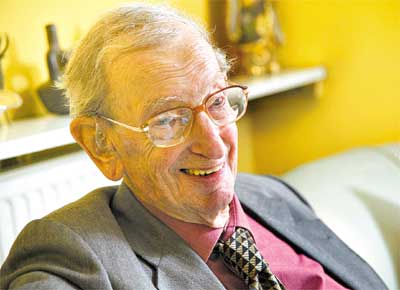
Bani Walid, a former Gaddafi stronghold, remains to be ‘liberated’, one year after the capture and murder of the Libyan dictator, the new regime has admitted.
Speaking on Libyan television late on Friday, Libyan leader Mohammed Magarief said the new regime had struggled to impose their authority on a country awash with weapons.
The national congress leader claimed the town of Bani Walid, some 160 kms (100 miles) south of Tripoli, had become a ‘safehaven’ for those who were ‘outside the law.’
He blamed“delays” in the formation of the army and police and the failure to disarm and integrate former rebels for the chaos in Libya.
“The campaign to liberate the country has not been fully completed.
“…the spread of chaos that has lured the old regime to infiltrate the country’s institutions inside and to conspire with the regime loyalists on the outside.
“And the chaos has lured others to kidnappings, stealing, and to create non-legitimate prisons. What has happened in Bani Walid in the last few days falls under this … it has become a safe haven for a large number of those who are outside of the law.”
Militias, aligned with the Defence Ministry, have shelled the hilltop town of 70,000 for several days. Many of those in the militias were from the rival town of Misrata, that are angry at the death of rebel fighter Omran Shaban (pictured above) after two months in detention in Bani Walid.
Shaban, from Misrata, was the man who found Colonel Muammar Gaddafi hiding in a drain pipe in Sirte on October 20, 2011.
Libya’s congress ordered the Defence and Interior Ministries to find those responsible for abducting Shaban and suspected of torturing him to death.
Several children have been injured after Israeli forces shelled areas east of Khan Younis. The Israeli military said it had targeted two members of “global jihadist” groups which were suspected of involvement in a cross-border attack from Egypt in June that left one Israeli dead.
Medical sources in Gaza said an Israeli shell had landed east of Khan Younis, injuring five people, among them several children.
Earlier today, rockets launched from Gaza landed in Israel’s Eshkol region and near Kerem Shalom, although no-one was hurt.
Shrapnel from the mortars and rockets fired into southern Israel on Monday caused some damage to at least one building in Eshkol.
Afterwards, the local authorities asked residents to stay close to shelters.
The military wings of Hamas and Islamic Jihad said the attack was a response to an Israeli air strike on Sunday.
Eight civilians, including two children, were injured in that strike, when a missile hit a motorbike ridden by two militants as it travelled through the southern town of Rafah.
One of the militants, Abdullah Maqawi, died of his wounds on Monday, while the other is seriously hurt.
Hamas’s military wing, the Izz al-Din Qassam Brigades, and that of Islamic Jihad, the al-Quds Brigades, announced that the rocket fire was a response to “Zionist crimes”.
“In response to the injury of civilians in the most recent strike on Rafah, the Qassam Brigades and the al-Quds Brigades fired a number of rockets at enemy military positions,” a Hamas statement said.
In a statement, the Israeli military said: “In response to this morning’s rocket barrage at southern Israeli communities, the [Israel Defence Forces] targeted Hamas terror activity sites and terrorist squads responsible for the rocket fire from the Gaza Strip.
“The IDF will not tolerate any attempt to harm Israeli civilians, and will operate against anyone who uses terror against the State of Israel. The Hamas terror organisation is solely responsible for any terrorist activity emanating from the Gaza Strip.”
More than 470 rockets have been fired from the Gaza Strip at Israel this year, not including those launched on Monday, the statement added.
Eric Hobsbawm, the great historian who inspired thousands, probably more, died during the early hours of Monday morning at the Royal Free Hospital, his daughter Julia confirmed today. He had been suffering from pneumonia.
In a statement his family said: “He will be greatly missed not only by his wife of 50 years, Marlene, and his three children, seven grandchildren and great grandchild, but also by his many thousands of readers and students around the world.”
Born to Jewish parents in Egypt in 1917, the year of the Russian Revolution, Prof Hobsbawm’s life and works were shaped by his commitment to radical socialism.
His British father and Austrian mother moved to Vienna when he was two, then to Berlin.
He joined the Communist Party aged 14, after he had been orphaned and was living with his uncle.
In 1933, with Hitler’s grip on power tightening, he came to London. After gaining a PhD from Cambridge, he published his first book in 1948.
Hobsbawm was appointed a lecturer at Birkbeck College in London in 1947, spending his entire career on the faculty and eventually being appointed president.
His best-known works were the three-volume history of the 19th Century and his book the Age of Extremes which covered the eight decades from WWI to the collapse of communism in Europe.
He published his final book, How to Change the World, in 2011.
The drone attacks are carried out by the Central Intelligence Agency and not the US military since Pakistan is not a zone of armed conflict, unlike neighbouring Afghanistan.
Earlier this year, President Barack Obama insisted the strategy was “kept on a very tight leash” and that without the drones, the US would have had to resort to “more intrusive military action”.
The report, by Stanford University and New York University’s School of Law, says top commanders only account for an estimated 2% of drone victims.
The report also details hundreds of civilian casualties and the effects of drone strikes on the local population. It cites data from the Bureau of Investigative Journalism estimating that between 474 and 881 civilians have been killed in strikes between 2004 and 2012.
“In the United States, the dominant narrative about the use of drones in Pakistan is of a surgically precise and effective tool that makes the US safer by enabling ‘targeted killings’ of terrorists, with minimal downsides or collateral impacts. This narrative is false,” according to the report, Living Under Drones.
“Publicly available evidence that the strikes have made the US safer overall is ambiguous at best,” it says, adding that targeted killings and drone attacks undermine respect for international law.
The report says that the US government rarely acknowledges civilian casualties, though there is significant evidence that civilians are being injured and killed.
The report highlights the impact of drone attacks on civilians in Pakistan’s tribal regions. Citing “extensive interviews with the local population”, the authors say:
children are being taken out of school out of fear of a drone-strike or to compensate for income lost from a dead or wounded relative
there is “significant evidence” of the practice of “double-tap” strikes in which rescuers arriving at the scene are targeted in follow-up attacks
drones flying overhead have led to “substantial levels of fear and stress… in the civilian communities”
as well as injury or death, the attacks cause property damage, severe economic hardship and emotional trauma for the injured and their families
people are afraid to attend gatherings such as funerals for fear of attack
Datta Khel drone strike
According to the report, 42 people were killed, mostly civilians, when they gathered at a bus depot on 17 March 2011 for a “jirga” (community meeting) to settle a dispute over a nearby mine.
The Pakistani military commander said the local military post had been alerted 10 days beforehand so those at the meeting were not concerned by drones overhead.
Several missiles were fired. Nearly all those who died were heads of large households.
The jirga had been chaired by Malik Daud Khan, a political liaison between the government, military and other tribal leaders.
Source: Living Under Drones – Stanford Law School and NYU School of Law
A soldier killed in Afghanistan has been named as Capt James Townley of the Corps of Royal Engineers. died in Helmand province on Friday – the day before his 30th birthday – in a shooting incident not thought to be the result of hostile action.
His death brings the number of British military deaths since operations began in Afghanistan in 2001 to 431.
Of the 342 coalition soldiers who have lost their lives this year, 257 come from the US with the UK the next highest with 37.
A total of 3,189 Nato soldiers have died since the conflict began in 2001, with the US losing 2,121 in the Af-Pak region.
In a ruling on Thursday, Ofcom said: “In July 2011, in light of the public debate about phone hacking and other allegations, Ofcom confirmed that it had a duty to consider whether Sky was fit and proper to continue to hold its broadcast licences.
“Ofcom considers that, on the evidence currently available and having taken into account all the relevant factors, Sky is fit and proper to hold its broadcast licences.”
Ofcom said, however, that “should further evidence become available” it may review the issue. Criminal investigations into phone hacking continue and several court cases involving senior executives from News International are pending.
However, the conduct of James Murdoch, who resigned as chairman of BSkyB in April (but remains a non-executive director) and has also relinquished his role at the UK newspaper group, was questionable, Ofcom concluded.
The regulator said: “Ofcom considers on the basis of the evidence available to date… James Murdoch’s conduct in relation to events at NGN [the newspaper group] repeatedly fell short of the conduct to be expected of him as a chief executive officer and chairman.
“However, Ofcom considers that the evidence available to date does not provide a reasonable basis to conclude that James Murdoch deliberately engaged in any wrongdoing.”
While acknowledging that many of the circumstances over phone hacking were outside of Mr Murdoch’s control or unknown to him, Ofcom criticises severely his failure to make himself aware of the deepening scandal.
“We consider James Murdoch’s conduct, including his failure to initiate action on his own account on a number of occasions, to be both difficult to comprehend and ill-judged.
“We consider that the events… raise questions regarding James Murdoch’s competence in the handling of these matters, and his attitude towards the possibility of wrongdoing in the companies for which he was responsible,” Ofcom said.
The regulator said that Mr Murdoch’s non-executive role on the BSkyB board did not impact on its “fit and proper” test, because there were other “experienced individuals who would be expected to be capable of exercising effective independent oversight”.
Ofcom continued: “We recognise that whether it is appropriate for James Murdoch to be a director in light of the events is a matter for the board and shareholders of Sky.”