
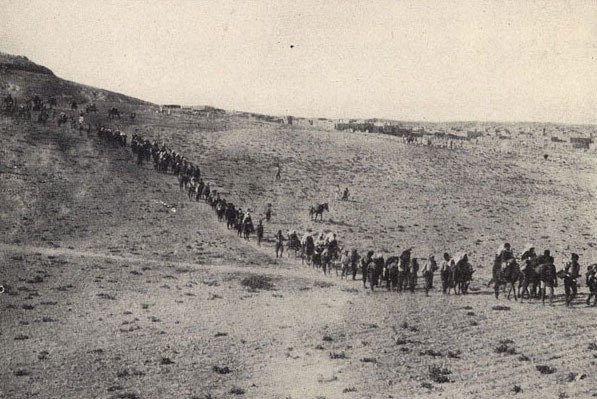
ANALYSIS – As the First World War began to turn on the Ottoman empire, Armenian nationalists pursued their dream of a Greater Armenia stretching all way to the Caucasus. They committed unspeakable acts against the Muslim civilian population whilst under Russian and French tutelage.
Here are some accounts ..
“I arrived at Bayburt on August 8 1917. What I saw was terrifying,” observed Tatiana Karamel, a nurse Russian Red Cross. “Armenians under the Russian administration were carrying out horrifying wild atrocities against the Turks in Bayburt and Ispir.
“The rebels named Arshak and Antranik slaughtered the children in the orphanage, I worked at, with their daggers. They raped young girls and women.
“They took away 150 children with them, while they were withdrawing from Bayburt and killed most of them while they were still on the way.”
Old men and women, who had made it past a century of living, recounted some of the horrors they witnessed in their youth, when Armenian rebels committed atrocities in the eastern and southern Anatolia, all the way through to modern-day Azerbaijan.
Sirri Huseyinoglu, from Alacain, in Erzurum, remembered: “I was 19 during the period of Armenians atrocities. The Armenians had established an organisation.
“An Armenian general called Antwon-ich led them. They started atrocities in the villages
“At Erzurum they massacred 6 or 7000 people. They imprisoned them in huts
They tied a quilt on a water buffalo then they poured gasoline on the quilt and set it o on fire, They closed the buffalo in the hut. It went wild in the hut killing people.
“Makes a man go out of his mind to remember it.”
Mehmet Ackal , 106, Sambeyli, Adana : “Not one Muslim man was left they were imprisoned and killed. Children were boiled in water. They said ‘We are serving you lamb’ and made women eat their husbands.”
On Russian commander wrote on Jan 29, 1915 that the Armenian rebels were behaving in an “undisciplined and immoral” manner, “subjecting the civilians to violence” during the takeover of Van.
To this day, the stories of these people is ignored, written out of history as an irrelevance.
Europeans prefer the version offered by Jewish writer and poet Franz Werfel.
Fearing for the fate of Jews in Nazi Germany, he wrote an allegory called ‘The 40 Days of Musa Dagh,’.
In this work, Werfel substituted the Nazis with the Young Turks, and the Jews with the Armenians.









 Template - News, Current Affairs and Sport Website